
Welcome to Care Full’s Anti-Manifesto. We know quick fixes won’t solve the challenges entrenched within the design of our economy, and yet that’s what every party is presenting us with.
So, where a manifesto sets out how parties will change policy, we’re publishing an anti-manifesto to challenge us to think about what systemic change they should be aiming for. It’s our bid to try to join up current disparate commitments related to care into a bolder vision of what a more caring future economy might look like.
We believe a manifesto should commit to policies which centre:
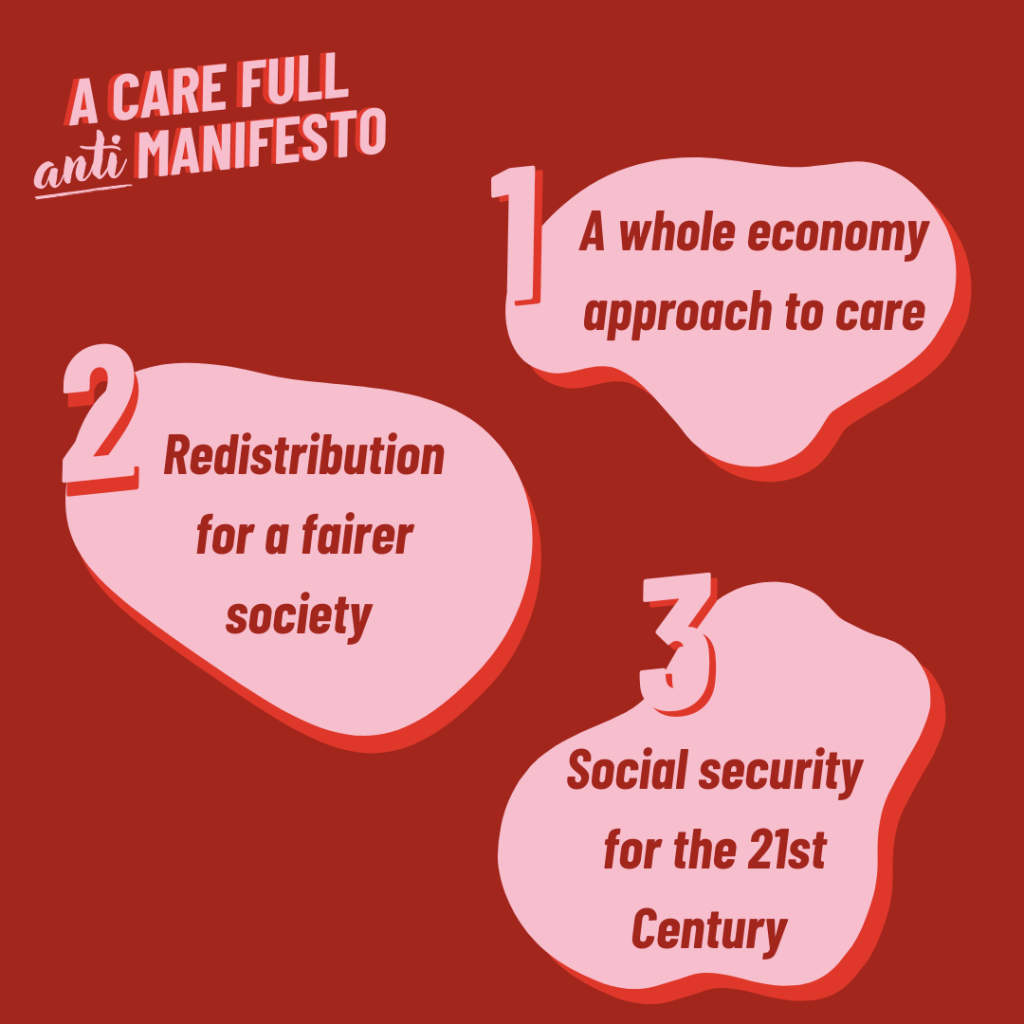
A whole economy approach to care
Approximately 820,000 people benefit from adult social care support. When we put this in contrast to the more than 5 million unpaid carers in England and Wales we start to see that looking at adult social care in isolation is only part of what makes a caring society, yet it’s where the discussion tends to start and finish.
At Care Full we believe that to encompass care in all its forms, a whole economy approach is needed to enable us all to care for ourselves, each other and the planet. That means a system-wide reframing of what we value. Within our current economy, we’ve accepted much of the care within our communities to be unpaid, deemed as unskilled and left any alternatives under-discussed. The patriarchal roots of our economic norms continue to weave through how we view care and without shifting these extractive mindsets we won’t be able to place care more centrally in our lives.
Designing a new economy will only deliver something better if we work with people in a participatory way. It’s likely that some of the answers will sit with improving and investing in public services, though are unlikely to be as simple as shifting the funding model.
We’ve also seen commitment from the Liberal Democrats to introduce free personal care. This manifesto’s starting point should be matched with a wider story about an economy that enables us to care – including tackling the cost of living crisis – so that everyone has the foundations they need to live well. Without this, free personal care will just patch up one part of a system without building consensus for more investment in care.
We also need to see meaningful engagement with the cost of living crisis, something the two major parties at least seem keen to avoid. The cost of living is making the lives of millions harder, and when it comes to care, making the balance between our own wellbeing, caring for someone and having enough money to live impossible. Policies like the two-child limit push children and their families into poverty, yet neither Labour nor the Conservatives are open to talking about it. Creating a connection between the wider economy and our caring lives is essential to lay the foundations for change.
Redistribution of wealth for a fairer society
There is huge inequality in the UK and the gulf between rich and poor is only getting worse. According to the World Inequality Lab the top 10% of the UK population held 57% of the wealth in 2021, up from 53% in 1995.
This General Election both major parties are tying themselves in knots trying to prove that the other is going to up your taxes and make households worse off. But this messaging is deeply regressive and fails to acknowledge that investment is good and that not every household should share the same tax burden. A tax on wealth, income from assets, or a higher threshold for the uber-rich would all play a role in ensuring that our society has the resources it needs and the wealth across our nation – and there is lots of it – is more fairly shared.
A narrative that tackles this economic inequality head on would also acknowledge the cost of caring, of raising a family and the impact of intergenerational inequality on the economy of the future. Ideas like Community Wealth Building are growing in ambition and evidence, offering an overhaul across local economies to challenge a concentration of wealth.
But, instead of this, we’re looking at antagonistic policy recommendations that do nothing to improve the financial situation of many of us. The Conservative’s mandatory National Service for 18 year olds will see hundreds of thousands of young people take on voluntary work at the expense of paid work and any caring responsibilities. The Learning and Work Institute has found that 1 in 23 young adults (people aged 16-24) are unpaid carers and almost 30% of 15-19 year olds live in poverty. Mandatory National Service is unlikely to address the underlying issues that affect these young people’s lives (or make any political party suggesting it popular). This is wildly out of sync with the complexity of young people’s lives today, where they face high rents, low pay, caring responsibilities and a debt economy.
We think there needs to be a meaningful exploration for what a 21st century population needs now and as we move into a more challenging future. New housing options, different models of work, addressing the wealth gap and developing solutions that meet the needs of the complex families that we all find ourselves in.
Social security for the 21st Century
The Joseph Rowntree Foundation estimate the cost of poverty on the healthcare system is £29 billion and 31% of carers live in poverty. We often see care and healthcare as mutually supporting systems. You might hear about unpaid care saving the NHS money or reducing waiting lists on hospitals freeing up care, but we want to see the conversation go further and think about how our economy can help us lead healthier lives. A conversation about preventative care would reframe the policy solutions we need.
In the here and now, there is no question that investment in our NHS is needed, that wait times need to go down, that health and care workers need to be better paid and less overstretched. Labour’s pledge for faster NHS treatment starts to prod at these challenges though the ambition could go further. Just like pledges related to social care, focusing on one public service alone as a solution to issues facing unpaid carers will not address the socioeconomic challenges they face. It’s one of the reasons why we think more time should be spent seriously looking at alternative models of collective infrastructure.
Crucial to this is a 21st Century approach to social security. Our benefits system is making us sick, keeping people in poverty, adding stress to people’s lives and in cases stopping people from accessing the money they need to manage their health and wellbeing. After years of soaring energy prices, for example, much of the money will merely pass through people’s bank accounts before going to the private companies making record profits.
What if we were able to meet our basic needs without making profit for others – through models like Universal Basic Services? Or know that if our circumstances changed, perhaps as we started to care for someone, there would always be support to ensure we didn’t need to live in poverty because of this – through a basic income model? There are lots of alternatives to the low trust, high penalty and ungenerous system we currently have and any future government should explore these to invest in its people.
Hope for the future
These are just some of the ways we’d like to see our leaders-in-waiting talk about the change they want to be part of. Our economy, our lives and our ability to care for each other cannot go on like it is. We need to be able to talk with confidence about investing in our people, our relationships and the planet if we are to have any kind of liveable future. Our view of care is a crucial part of this, and we could go a lot further in how we connect unpaid care, social care, childcare and all types of caring relationships in our lives to the systems that surround us. As the manifestos start to come out this week, we hope there is engagement in what systemic changes parties want to achieve, not just policies which add a short-term shine to existing broken systems.

 Care Full
Leave a comment